
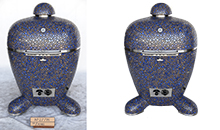
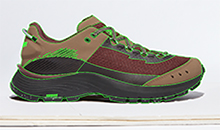


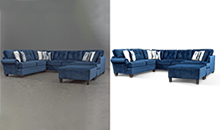

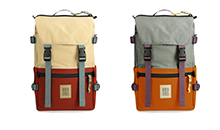
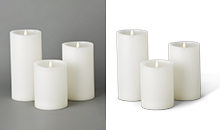



You’ve probably noticed it. Almost every top-selling product on Amazon, Shopify, or Etsy sits against a clean white background. There’s a reason for that. White backgrounds remove distractions. They put all focus on the product. And they make your listing look polished and trustworthy.
The good news? You don’t need a professional studio to get there.
With the right setup and a little patience, you can shoot clean white background photos right at home — and then edit product photos for Shopify that look like they came from a commercial shoot.
Let’s walk through exactly how.
What You Actually Need (No Studio Required)
Before you start, gather a few basics. Most of this you probably already have.
The essentials:
- A smartphone with a decent camera (iPhone 13+ or any modern Android works great)
- A white foam board or white poster paper (around $5 at any craft store)
- Natural window light OR two affordable softbox lights
- A small table or flat surface
- A tripod or phone stand
That’s it. No expensive gear. No rented space.
Step-by-Step: Setting Up Your DIY White Background Shoot
Step 1: Choose the Right Light Source
Lighting makes or breaks a product photo. Natural light from a large window is your best free option.
Set up your shoot on a bright, overcast day. Direct sunlight creates harsh shadows. Cloudy light is softer and more even — exactly what you want.
If you’re indoors without great windows, two budget softbox lights (around $40–$60 a pair on Amazon) work well. Place one on each side of your product at a 45-degree angle.
Step 2: Build Your Sweep
A “sweep” is the curved white background that creates a seamless look — no sharp corners, no horizon line.
Here’s how to make one in two minutes:
- Tape a large white foam board to a wall
- Curve it gently onto your table surface
- Let it flow naturally — don’t crease it
This gives you that clean, infinite-white effect you see on professional product pages.
Step 3: Position Your Product
Place your product in the center of the sweep. Keep it a few inches away from the background — this reduces shadows behind the item.
Shoot from eye level or slightly above, depending on the product. Flat lays work well for clothing, accessories, and small items.
Step 4: Dial In Your Camera Settings
On a smartphone, tap the product on your screen to lock focus and exposure. Turn off HDR if the background looks grey or washed out.
On a DSLR or mirrorless camera:
- Keep ISO low (100–200) to reduce noise
- Use a narrow aperture (f/8–f/11) for sharpness
- White balance: set to “Cloudy” or “Auto” and adjust in editing
Common Problems — and How to Fix Them
| Problem | Likely Cause | Quick Fix |
|---|---|---|
| Grey background, not white | Underexposed or wrong white balance | Increase exposure; adjust in editing |
| Harsh shadows | Single direct light source | Add a reflector or second light |
| Blurry product | Camera shake or wrong focus | Use a tripod; tap to focus on product |
| Uneven lighting | One-sided light setup | Add a white card on the opposite side to bounce light |
The Part Most People Skip: Editing
Shooting gets you 70% of the way there. Editing closes the gap.
Even with a great setup, your background might look slightly off-white in the final image. That’s normal. A quick edit fixes it.
You can use Adobe Lightroom, Photoshop, or even free tools like Canva or Snapseed for basic corrections.
But for Shopify, Amazon, or Etsy listings — especially in bulk — the background needs to be a true, pure white. That’s where professional background removal and photo retouching services make a real difference.
If you’re spending hours editing each image, it’s worth outsourcing. Services like background removal and photo retouching from specialists can handle large batches quickly — at a fraction of what you’d spend on a studio.
Tips for Specific Product Types
Clothing & Apparel
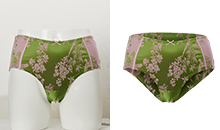
Flat lays on a white foam board work well. For a “worn” look without a model, try the ghost mannequin technique — it gives tops and jackets a 3D, professional appearance without hiring anyone.
Jewellery
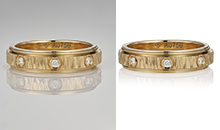
Jewellery is tricky. Reflections, tiny details, and shiny surfaces all need careful handling. Shoot macro, use diffused lighting, and consider professional jewellery retouching for the final polish.
Products with Complex Edges
Furry items, transparent glasses, or anything with a complicated outline? These are harder to cut out cleanly in basic editors. Specialist image masking services handle these with precision.
Quick Tips & Tricks
- Shoot in RAW format if your camera allows it — you’ll have more control in editing
- Use a grey card to set correct white balance before shooting
- Take multiple shots of each product — slight angle changes matter
- Keep a consistent shooting distance across products for a uniform look on your store
- Check images on a white background screen before uploading — grey tones show up there
FAQ
- Do I need a lightbox?
Not necessarily. A DIY foam board sweep with good window light often beats a cheap lightbox. Lightboxes are useful for very small items though.
- What’s the best free editing app for white backgrounds?
Snapseed (mobile) and GIMP (desktop) are solid free options. For Shopify-ready images, Photoshop or professional retouching services give the cleanest results.
- How do I get a pure white background on Shopify?
Shopify recommends images with a pure white background (RGB 255, 255, 255) for best display. Editing in Lightroom or using a clipping path service ensures accuracy.
- Can I edit product photos for Shopify using my phone?
Yes. Apps like Adobe Lightroom Mobile, Remove.bg, and TouchRetouch work well for basic edits. For high-volume stores, desktop editing or professional services are more efficient.
- How many photos do I need per product?
Most top Shopify stores use 5–8 images per product: front, back, side, detail shot, and at least one lifestyle image.
Final Thoughts
You don’t need a studio. You need decent light, a white sweep, and a steady hand.
Get the shot as clean as possible in-camera. Then edit product photos for Shopify to bring them the rest of the way. If editing is slowing you down, professional services are worth every penny — especially when you’re scaling.
Clean product images build trust. Trust drives sales. It’s that simple.